
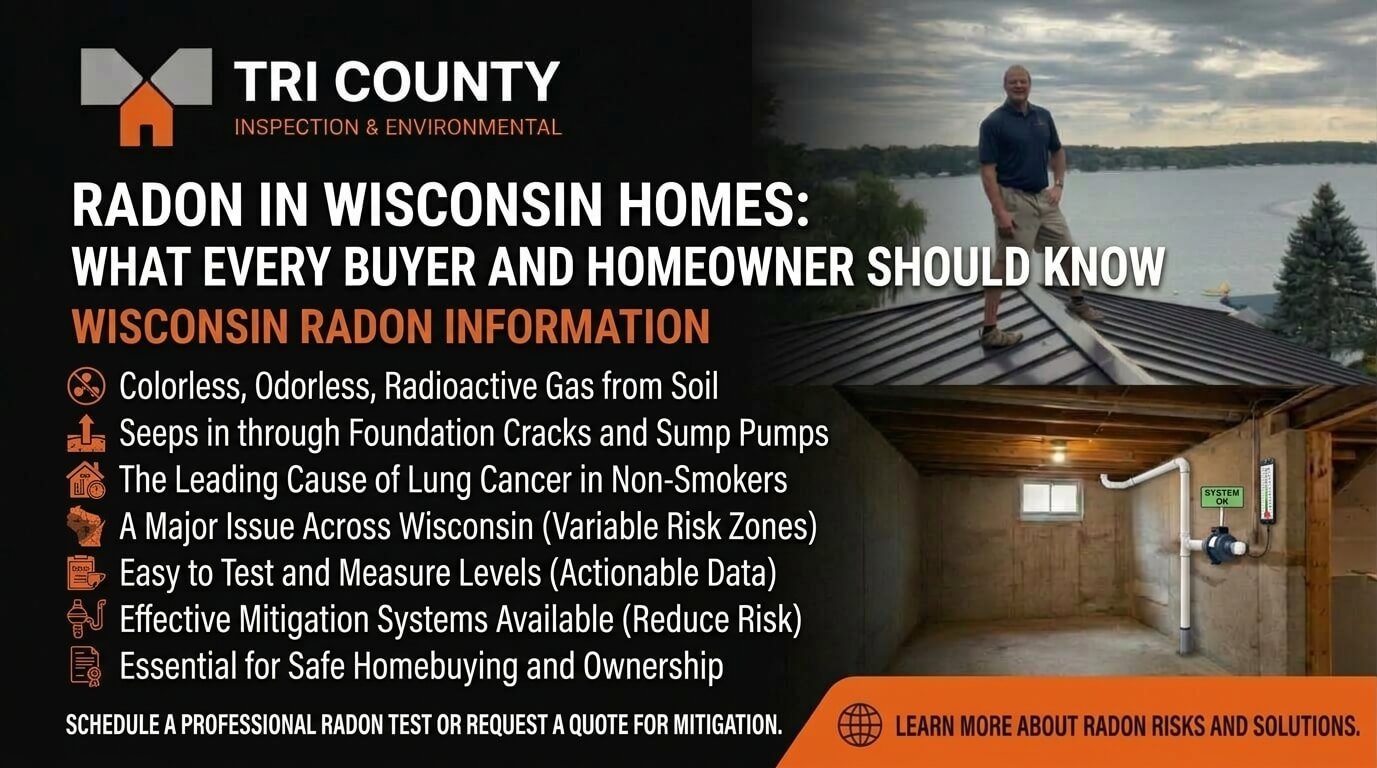
Radon in Wisconsin Homes is a concern that nobody can see, smell, or spot on a walkthrough. A house can be well built, well maintained, and freshly renovated and still have radon levels well above what the EPA considers safe. In Wisconsin, where most homes sit on full basements in direct contact with the soil, it is a question every buyer and homeowner should be able to answer with a number rather than a guess.
Here is what radon is, how common it is in Wisconsin, how testing works, and what to do with the result, whether you are buying a home or have lived in one for years.
What Radon Is and Why It Matters
Radon is a naturally occurring radioactive gas produced as uranium in soil and rock breaks down. Outdoors, it disperses harmlessly. Indoors, it can accumulate, entering through foundation cracks, floor-wall joints, sump pits, utility penetrations, and the gaps around them.
The concern is long-term exposure. The EPA estimates that radon is responsible for about 21,000 lung cancer deaths in the United States each year, making it the second leading cause of lung cancer overall and the leading cause among people who have never smoked. The risk builds over years of breathing it, which is why it matters most in the place you spend the most time: your home.
How Common Is Radon in Wisconsin?
Common enough that every home should be tested. The Wisconsin Department of Health Services estimates that roughly one in Wisconsin homes has elevated radon levels, and those homes are spread across the state rather than concentrated in one area.
Just as important, radon is not predictable from the outside. Two houses on the same street, built by the same builder in the same year, can test very differently because of small differences in the soil beneath them and how each foundation is sealed. A neighbor’s low result tells you nothing reliable about your house.
Why Radon in Wisconsin Homes Are Especially Prone
Three features of Wisconsin housing make radon worth taking seriously here:
- Full basements. Most radon in Wisconsin homes comes from below-grade basements with large areas of concrete in direct contact with the soil, giving radon more surface area to enter.
- Long heating seasons. In winter, when warm air rises and escapes through a house’s upper levels, it creates slight negative pressure at the lowest level that draws soil gas through the foundation. The longer the heating season, the longer that effect runs.
- Finished basements. Many Wisconsin families use the basement as living space, bedrooms, family rooms, and home offices, which puts people in the part of the house where radon levels are typically highest.
How Radon Testing Works
There are two broad types of radon tests. Short-term radon tests measure levels over a few days and are what is used in nearly every real estate transaction, because they produce a result within the inspection contingency period. Long-term tests run for more than 90 days and give a better picture of a home’s average year-round level, which makes them useful for owners who are not on a deadline.
For a short-term test to be valid, the house needs to be kept under closed-house conditions: windows and exterior doors kept closed, except for normal entry and exit, starting before the test and continuing for its entire duration. The EPA recommends that real estate radon tests run for a minimum of 48 hours. Professional testing typically uses a continuous radon monitor, which records hourly readings and can flag interference, such as opened windows or a moved device, an important safeguard when the result affects a purchase.
Testing is done in the lowest level of the home that is used or could be used as living space, which in most Wisconsin homes means the basement.
Understanding Your Results
Radon is measured in picocuries per liter of air (pCi/L). The figures that matter:
- 4.0 pCi/L or higher: the EPA action level. The EPA recommends fixing the home.
- Between 2.0 and 4.0 pCi/L: the EPA recommends considering a fix. There is no known safe level of radon, and lower is better.
- Below 2.0 pCi/L: generally no action needed, though retesting after major renovations is sensible.
A single elevated result is not a reason to panic, and it is not usually a reason to walk away from a house. It is a reason to mitigate, and mitigation is one of the more dependable fixes in residential construction.
Radon and Buying a Home
For a buyer, timing is everything. Order the radon test at the same time as the home inspection so the result arrives before your contingency deadline. If the seller already has a recent test result or an existing mitigation system, ask for the documentation, but a buyer-ordered test under controlled conditions is still the most reliable basis for a decision.
If the result comes back at or above 4.0 pCi/L, the usual options are to ask the seller to install a mitigation system before closing, to negotiate a credit so you can install one yourself, or to adjust the price. Because the problem has a well-understood fix, it is usually resolved through negotiation rather than ending the deal. If the seller installs the system, make sure a post-mitigation test confirms it is working.
If You Already Own Your Home
If you have never tested, test. It is inexpensive, and nothing else will tell you what you are breathing. You should also retest after anything that changes how air moves through the lower level of the house: finishing the basement, major foundation or waterproofing work, a new HVAC system, or significant air-sealing and window replacement. A home that tested low ten years ago is not guaranteed to test low today.
If your home already has a mitigation system, the EPA recommends retesting at least every two years to confirm it is still doing its job, and checking the system’s pressure gauge periodically.
How Radon Mitigation Works
The most common approach is sub-slab depressurization. A pipe is installed through the basement floor into the soil or gravel beneath it, and a continuously running fan draws radon from under the slab and vents it outside above the roofline before it can enter the house. Visible cracks and openings are sealed as part of the work, but sealing on its own is rarely enough to bring levels down reliably.
The EPA notes that most homes can be fixed for about the same cost as other common home repairs, and a properly designed system typically reduces radon levels substantially. Any system should be followed by a post-mitigation test to confirm the result.
Frequently Asked Questions
1. Should every home in Wisconsin be tested for radon?
Yes. Wisconsin DHS estimates that roughly one in ten Wisconsin homes has elevated radon, and there is no way to predict which ones without testing. Age, construction quality, and neighboring results are not reliable indicators.
2. What radon level is considered safe?
The EPA action level is 4.0 pCi/L, and the EPA recommends considering mitigation between 2.0 and 4.0 pCi/L. There is no level that is considered completely risk-free; lower is always better.
3. How long does a radon test take during a home purchase?
The EPA recommends a minimum of 48 hours for short-term tests used in real estate transactions, with closed-house conditions maintained throughout. Results are typically available shortly after the test ends, well within a normal inspection contingency period.
4. Can I do a radon test myself?
Do-it-yourself test kits are useful for homeowners checking their own house. For a home purchase, a professional test with a continuous radon monitor is the better choice because it records hourly readings, documents testing conditions, and can detect tampering or interference that would invalidate the result.
5. Is high radon a reason not to buy a house?
Rarely. Radon has a dependable, well-established fix. In most transactions, an elevated result is handled by having the seller install a mitigation system or by negotiating a credit, followed by a post-mitigation test to confirm levels have come down.
6. Do newer homes need radon testing?
Yes. New construction can have elevated radon just as older homes can. Some newer homes are built with passive radon-resistant features, but those still need to be tested to confirm they are working.
Schedule Radon Testing in Southeastern Wisconsin
Tri County Inspection & Environmental provides professional radon testing on its own or alongside a full home inspection across southeastern Wisconsin, including Madison, Milwaukee, Waukesha, Delafield, Lake Geneva, and Janesville. See all of our inspection and testing services.
Call 262-225-9668 or book your radon test online.