
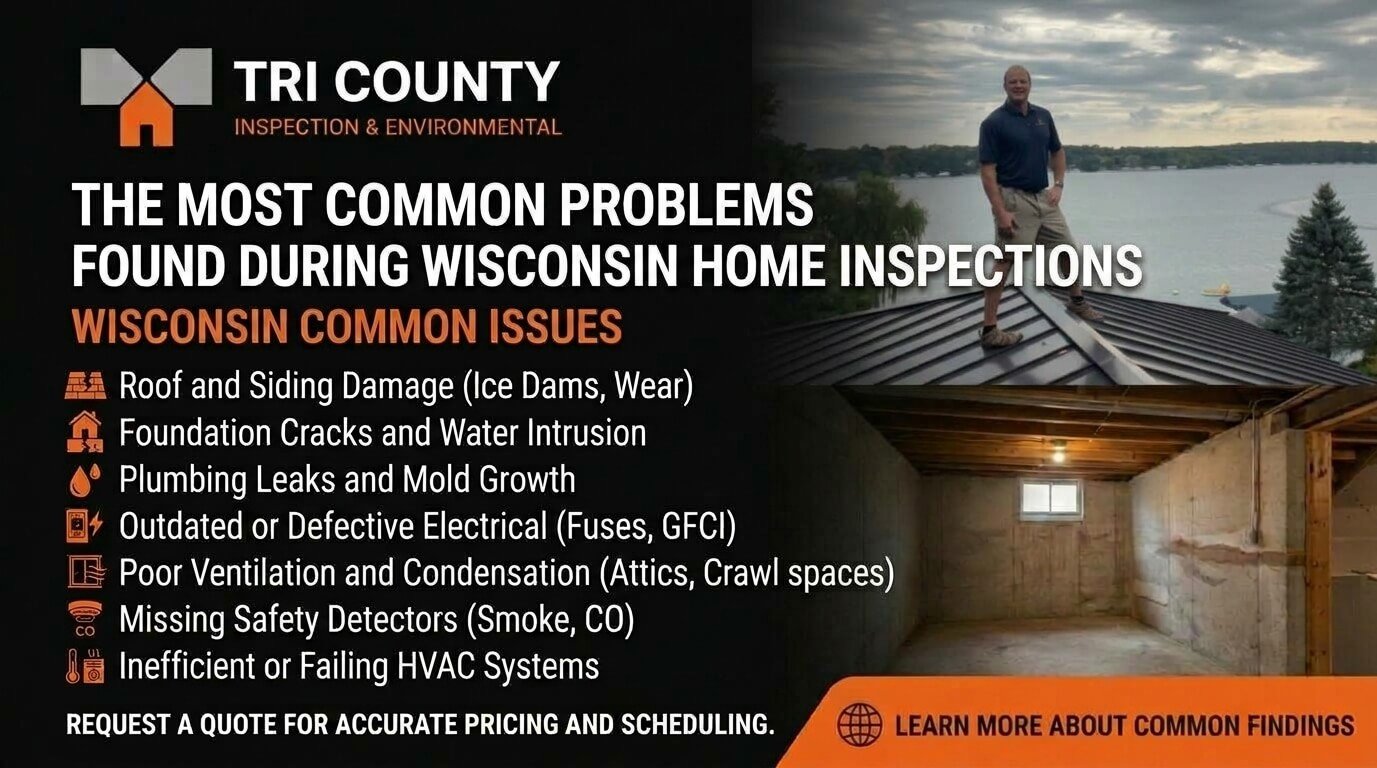
Wisconsin homes work harder than most. In a single year, a house here goes through humid ninety-degree summers, freeze-thaw cycles that run from November into April, heavy snow loads, and spring groundwater that rises fast. Add a housing stock where a large share of homes were built well before modern electrical, insulation, and drainage standards, and the findings start to look fairly predictable.
After more than twenty-five years of home inspections across southeastern Wisconsin, the same issues come up again and again. Here are the ten we report on most often, what causes each one, and what it actually means for a buyer, seller, or owner.
1. Water in the Basement
Almost every Wisconsin home inspection has a full basement, and the basement is where a large share of significant findings begins. White mineral staining on block walls, rust lines at the base of steel support posts, water marks on stored boxes, and damp or musty air all point to water that has been getting in seasonally, often for years before anyone noticed.
The cause is usually outside the house rather than inside it. Downspouts that discharge right at the foundation, soil graded toward the house instead of away from it, window wells with no drainage, and sump pumps that have failed or were never installed account for most of what we find. That is good news for a buyer: extending downspouts and correcting the grading resolves a surprising share of basement water problems for a few hundred dollars rather than a few thousand.
2. Foundation Cracks and Movement
The freeze-thaw cycle is hard on Wisconsin foundations. Water in the surrounding soil expands as it freezes and pushes laterally against the foundation wall. Over enough winters, this produces the pattern we see constantly in concrete block basements: a horizontal crack running along the wall at roughly mid-height, or stair-step cracking that follows the mortar joints.
Not every crack matters. Thin vertical cracks in poured concrete are usually normal curing shrinkage. What matters is displacement whether the wall has actually moved inward, and how far. A four-foot level held flat against the wall answers that question better than the crack itself does. Horizontal cracking with measurable bowing is a structural concern, and we refer it to a structural engineer rather than guessing at it.
3. Elevated Radon
Wisconsin sits on geology that produces radon, and the Wisconsin Department of Health Services estimates that roughly one in ten homes in the state has elevated levels. Radon is the second leading cause of lung cancer in the United States and the leading cause among people who have never smoked.
It cannot be seen or smelled, and there is no reliable way to judge a home’s level from its age, its condition, or the fact that a neighbor tested low. Two houses on the same street can read very differently. The only way to know is to test. The EPA action level is 4.0 pCi/L; above that, a mitigation system, typically a sealed pipe and fan drawing air from beneath the slab, brings levels down dependably and usually costs far less than buyers expect. Radon testing can be run alongside the inspection so you have the result before your contingency period closes.
4. Roof Wear and Ice Dam Damage
Asphalt shingles age faster in a climate that swings this far. We look for granule loss, curling and cupping at the edges, nail pops, brittle or lifting shingles, and failed flashing at chimneys, valleys, and roof-to-wall transitions. Flashing is where most roof leaks actually start, not the shingle field.
Ice damming is the specific Wisconsin problem. Warm air escaping into the attic melts snow on the upper roof; the meltwater runs down to the cold eave, refreezes, and builds a ridge of ice that forces the next round of water back up under the shingles. The stains that show up on upper-floor ceilings in February are the result. Worth understanding: the roof is rarely the real fault. The fault is almost always attic heat loss, covered in item seven below.
5. Outdated or Unsafe Electrical Systems
In older Wisconsin neighborhoods, the electrical system is the most common source of safety-related findings. The recurring ones:
- Federal Pacific Stab-Lok and Zinsco panels, which have a documented history of breakers failing to trip and which many insurers now decline to cover.
- Knob-and-tube wiring still energized in homes built before about 1950, often buried under blown-in attic insulation where it was never designed to sit.
- Ungrounded two-prong outlets and three-prong outlets retrofitted onto ungrounded wiring, which looks safe and is not.
- Missing GFCI protection at kitchens, bathrooms, garages, basements, and exterior outlets.
- Double-tapped breakers, open splices outside a junction box, and panel work done without a permit.
None of these are cosmetic. Several of them affect whether a buyer can get a homeowner’s policy written at all, which is why they belong in the report in plain language rather than buried in a checklist.
6. Aging Sewer Laterals
The sewer lateral, the pipe running from the house to the municipal main, is invisible during a standard inspection and is one of the most expensive things that can go wrong after closing. In older neighborhoods, these are clay tile, and clay tile joints are exactly what tree roots grow into. Add settling that creates low spots holding standing water, plus decades of corrosion in cast iron sections, and a line that drains acceptably on inspection day can fail within a year. The only way to see the condition is a camera: a sewer scope inspection run through the line from the cleanout.
Responsibility for the lateral generally falls on the property owner rather than the municipality, though where exactly that responsibility ends varies between municipalities. Replacement commonly runs into five figures, which makes a sewer scope one of the highest-value add-ons a buyer can order on an older home.
7. Attic Insulation and Ventilation
Attics tell us more about a Wisconsin house than almost any other space. Insulation that is thin, unevenly distributed, or compressed under stored boxes; bathroom exhaust fans discharging into the attic instead of through the roof or soffit; soffit vents blocked by insulation pushed into them; frost on the underside of the roof sheathing in winter; and dark staining on the deck where that frost has melted and refrozen repeatedly.
These are inexpensive problems with expensive consequences. Attic heat loss is the root cause of the ice damming described above, and the trapped moisture that results is the most common origin of roof-deck mold in this climate. Correcting ventilation and topping up insulation are routine work, and it resolves two or three other findings at the same time.
8. Crawlspace Moisture and Mold
Crawlspaces are the least-visited part of a house and are where we find some of the more serious conditions. Exposed soil floors with no vapor barrier, or a barrier that has been torn and pushed aside by previous trades; standing water after a wet spring; and visible growth on floor joists and subflooring overhead. Because the air in a crawlspace moves upward into the living space, what is growing down there does not stay down there. Where growth is visible, or the smell suggests it, mold testing establishes what is actually present rather than leaving the buyer to guess.
9. Asbestos and Lead in Older Homes
Homes painted before 1978 may contain lead paint, and homes built before roughly 1980 may contain asbestos in pipe and duct insulation, floor tile and the adhesive beneath it, textured ceiling finishes, and cement siding. Intact and undisturbed, these materials are generally not an immediate hazard. The risk arrives with renovation, sanding, cutting, and demolition, which is exactly what many buyers plan to start within weeks of closing. Asbestos and lead sampling before that work begins costs a fraction of what remediating a contaminated house costs afterward.
10. Aging Furnaces and Water Heaters
Mechanical equipment in Wisconsin runs a long heating season, and we routinely find furnaces and water heaters still in service past their design life. The findings that matter most are the safety ones: cracked or corroded heat exchangers, improper or disconnected flue venting, water heater temperature and pressure relief valves with no discharge pipe, combustion air supply that was adequate before the basement was finished and is not now, and missing carbon monoxide alarms.
An older unit still running is not automatically a defect. An older unit venting combustion gases into the basement is, and that distinction is the point of having the inspection done properly.
What These Findings Actually Mean
An inspection is not a pass-or-fail test, and almost no new-construction home comes back without findings. The purpose is to replace assumption with fact, so that whatever you decide next, you decide it knowing what you are dealing with.
For a buyer, the report is negotiating information and a maintenance roadmap for the first few years of ownership. For a seller, having the inspection done before listing removes the surprises that kill deals during the contingency period and lets you price with the findings already accounted for. For an owner with no transaction in sight, it is simply the cheapest way to find out which of these ten items is quietly in progress in your own house.
Frequently Asked Questions
1. What is the most common problem found during a Wisconsin home inspection?
Water getting into the basement. Most Wisconsin homes have full basements, and signs of past or ongoing water intrusion are among the findings we report most often. The cause is usually outside the house: downspouts discharging at the foundation, soil sloping toward the house, or a failed sump pump, which means it is often one of the less expensive problems to correct.
2. Should I test for radon when buying a home in Wisconsin?
Yes. The Wisconsin Department of Health Services estimates that roughly one in ten Wisconsin homes has elevated radon, and there is no way to judge a home’s level without testing it. Radon testing can be scheduled alongside the home inspection so the result is in hand before your contingency period ends.
3. Is a foundation crack a reason to walk away from a house?
Not usually. Thin vertical cracks in poured concrete are common and often cosmetic. What matters is whether the wall has moved. Horizontal cracking with measurable bowing in a block foundation is a structural concern, and we recommend evaluation by a structural engineer so you have a repair scope and cost before deciding.
4. Does a standard home inspection include the sewer line?
No. The sewer lateral runs underground from the house to the municipal main and cannot be seen during a standard inspection. A sewer scope inspection uses a camera to check the line for root intrusion, cracks, and low spots, and is strongly recommended on older homes.
5. Do older Wisconsin homes need asbestos or lead testing?
If the home was built before about 1980 and you plan to renovate, it is worth doing. Lead paint is common in homes painted before 1978, and asbestos can be present in pipe insulation, floor tile, and textured ceilings. These materials are generally not a hazard while intact; the risk comes when renovation disturbs them. Asbestos and lead sampling before work begins answers the question.
6. What happens if the inspection finds problems?
Almost every inspection does. The report gives you the information to decide what to do next: ask the seller for repairs or a credit, get a contractor or specialist to quote the work, plan the repairs yourself after closing, or in rare cases walk away. Your inspector remains available afterward to explain any finding in the report.
Schedule an Inspection in Southeastern Wisconsin
Tri County Inspection & Environmental provides residential and commercial property inspections, radon testing, mold testing, asbestos and lead sampling, sewer scope inspections, and environmental testing across southeastern Wisconsin, including Madison, Milwaukee, Waukesha, Delafield, and Lake Geneva. See the full list of services or the areas we serve.