
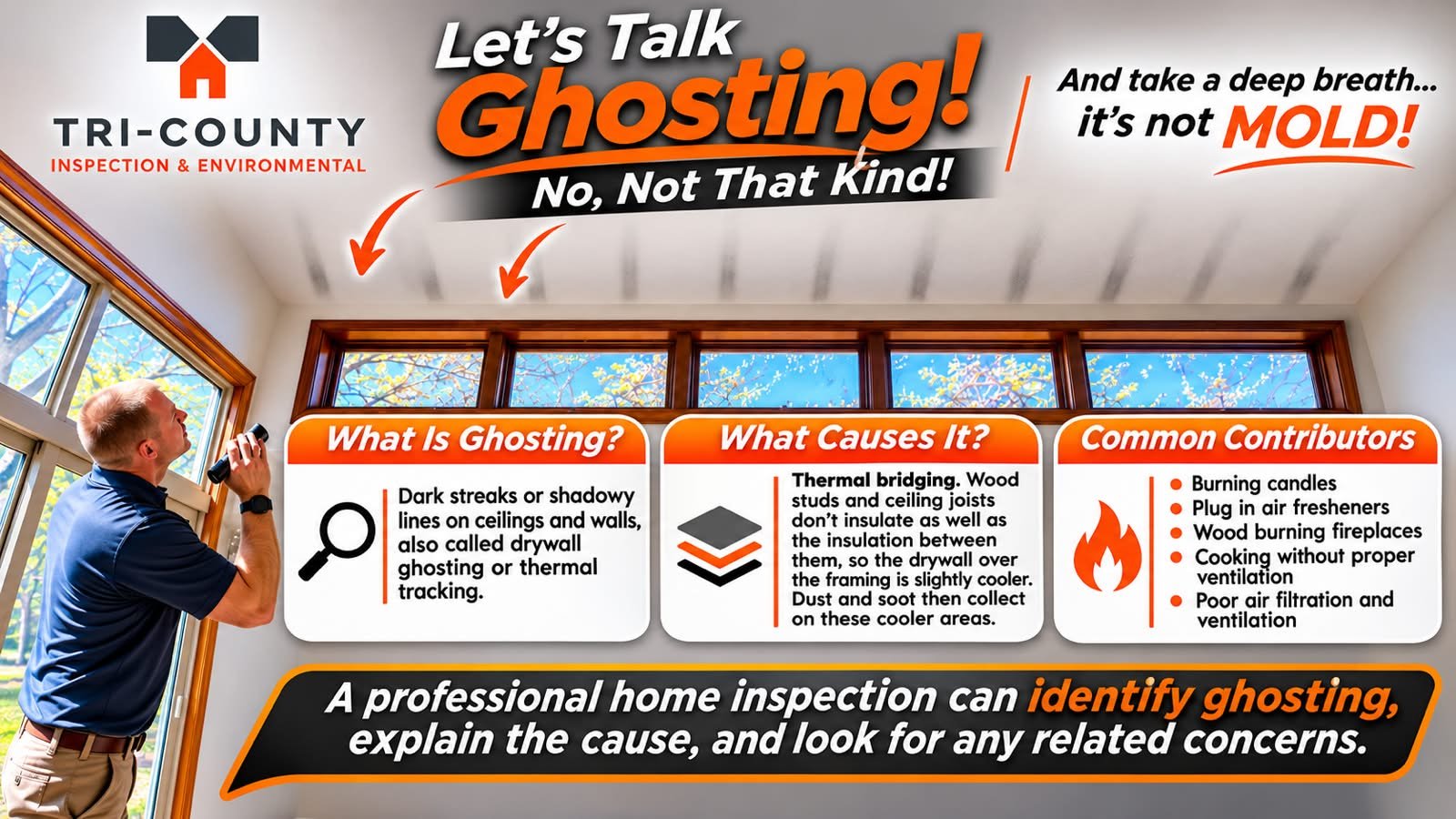
Dark streaks on your walls or ceilings? Before assuming it’s mold, you might be looking at something called drywall ghosting.
Have you ever noticed mysterious dark lines, shadowy streaks, or discoloration appearing on the walls or ceilings of your home? Sometimes these markings follow perfectly straight lines, outline ceiling joists, or appear around the edges of a room.
At Tri County Inspection & Environmental, we occasionally encounter this condition while performing residential home inspections throughout Southeastern Wisconsin.
This phenomenon is known as drywall ghosting, also called thermal tracking or thermal ghosting.
Although the discoloration can look concerning, drywall ghosting is often a cosmetic condition caused by airborne particles collecting on cooler drywall surfaces.
Understanding why it happens can help homeowners identify potential insulation deficiencies, ventilation concerns, and other conditions affecting their homes.
What Is Drywall Ghosting?
Drywall ghosting is the accumulation of airborne dust, soot, and other fine particles on certain areas of interior walls and ceilings, creating visible dark streaks or shadowy patterns.
These markings frequently appear:
- Along ceiling joists and wall studs
- At wall and ceiling intersections
- Around exterior walls and corners
- Near heating and cooling air registers
- On ceilings above windows and exterior doors
One of the most interesting characteristics of ghosting is that the dark markings can sometimes reveal the exact location of wood framing hidden behind the drywall.
But why does this happen?
What Causes Drywall Ghosting?
Understanding Thermal Bridging
One of the most common contributing factors to drywall ghosting is a building science phenomenon called thermal bridging.
That sounds complicated, but the explanation is actually pretty simple.
Wood studs and ceiling joists don’t insulate as well as the insulation installed between them. As a result, during cold weather, the drywall directly over the wood framing can become slightly cooler than the surrounding drywall.
Airborne dust and soot particles are more likely to accumulate on these cooler surfaces.
Over time, these particles can create dark lines that follow the framing behind your walls and ceilings.
Think of it this way: The insulation helps keep most of your drywall warmer, while the wood framing creates cooler pathways. Those temperature differences can influence where airborne particles collect.
This is why ghosting often appears as evenly spaced dark lines across a ceiling or wall.
Air leakage, missing or compressed insulation, and elevated indoor humidity can also contribute to these temperature differences and staining patterns.
What Household Activities Contribute to Drywall Ghosting?
Thermal bridging helps explain where ghosting develops, but the airborne particles circulating through your home help explain what creates the discoloration.
Several everyday household activities can contribute.
1. Burning Scented Candles
Candles, especially those that produce visible soot, can release fine combustion particles into the indoor air.
These particles circulate throughout the home and may eventually settle on cooler drywall surfaces.
2. Plug-In Air Fresheners
Plug-in fragrance products, including Glade and similar air fresheners, release fragrance compounds into the air.
Certain airborne compounds and residues may contribute to surface deposits under some conditions. However, plug-in air fresheners are not equivalent to burning candles and should not automatically be considered a source of soot or the cause of ghosting.
3. Wood-Burning Fireplaces
Wood-burning fireplaces and stoves can introduce soot and smoke particles into a home, particularly when combustion or venting conditions are poor.
These particles may contribute to staining on walls and ceilings.
4. Cooking Without Proper Ventilation
Cooking activities, particularly frying and high-temperature cooking, can release airborne grease, smoke, and fine particles.
Without adequate kitchen exhaust ventilation, these contaminants can circulate throughout the home and contribute to surface discoloration.
5. Poor Indoor Air Filtration and Ventilation
Inadequate ventilation, dirty HVAC filters, and ineffective air filtration can allow airborne particles to remain suspended indoors.
These particles may eventually accumulate on walls and ceilings, particularly where temperature differences or air movement encourage deposition.
The important takeaway: Thermal bridging helps create the conditions where ghosting develops, while airborne contaminants provide the particles responsible for the visible staining.
Is Drywall Ghosting Mold?
No, drywall ghosting itself is not mold. However, dark staining on drywall should not automatically be assumed to be ghosting.
Ghosting and microbial growth can sometimes look similar, especially when discoloration appears around exterior walls, ceiling corners, or areas with inadequate insulation.
Ghosting typically follows predictable patterns associated with framing, temperature differences, or airflow.
Mold growth, on the other hand, requires moisture and may be associated with elevated humidity, condensation, water intrusion, or other moisture-related conditions.
A visual inspection alone may not always be sufficient to distinguish between the two.
At Tri County Inspection & Environmental, we evaluate visible conditions and use appropriate inspection equipment when warranted to help determine whether additional investigation or environmental testing is recommended.
Is Drywall Ghosting a Serious Problem?
In many cases, drywall ghosting is primarily cosmetic and does not indicate a major structural defect.
However, it can provide useful clues about how a home is performing.
Ghosting may be associated with:
- Thermal bridging through wood framing
- Missing, uneven, or compressed insulation
- Air leakage around building components
- Inadequate ventilation
- Excessive airborne dust or combustion particles
- Indoor humidity and condensation concerns
While the staining itself may not be serious, identifying contributing conditions can help homeowners improve comfort, energy efficiency, and indoor air quality.
How Can Homeowners Prevent Drywall Ghosting?
Preventing drywall ghosting generally involves reducing airborne particles and addressing the conditions that allow those particles to accumulate.
Consider these practical steps:
- Reduce indoor soot production. Limit candles that produce visible smoke or soot, and maintain wood-burning appliances properly.
- Improve kitchen ventilation. Use a properly vented range hood when cooking.
- Maintain HVAC filtration. Replace air filters according to manufacturer recommendations and ensure the filtration system is appropriate for the equipment.
- Evaluate insulation deficiencies. Missing or poorly installed insulation can contribute to cold drywall surfaces.
- Address air leakage. Proper air sealing can help reduce unwanted airflow and particle deposition.
- Manage indoor humidity. Maintain appropriate humidity levels to reduce condensation risks.
Simply repainting the affected drywall without addressing the underlying conditions may allow the staining to return.
Can Drywall Ghosting Be Cleaned or Painted Over?
Yes. In many cases, ghosting stains can be cleaned and repainted once the contributing conditions have been addressed.
Depending on the severity of the staining, cleaning and the use of an appropriate stain-blocking primer may be necessary before repainting.
However, if soot production, inadequate ventilation, thermal bridging, or other contributing conditions remain unresolved, the discoloration may return.
Why Does Drywall Ghosting Matter During a Home Inspection?
At Tri County Inspection & Environmental, our home inspections go beyond simply identifying visible defects.
Understanding how building materials, insulation, airflow, temperature differences, and indoor environmental conditions interact is an important part of evaluating a home’s overall performance.
When we encounter dark streaking or unusual drywall discoloration, we consider the location, pattern, surrounding conditions, and potential contributing factors.
Depending on the circumstances, additional evaluation of insulation, ventilation, moisture conditions, or indoor environmental concerns may be appropriate.
A thorough home inspection isn’t just about identifying what is wrong. It’s about helping homeowners understand why a condition exists and what it may mean for their property.
Frequently Asked Questions About Drywall Ghosting
1. What causes black lines on my ceiling?
Black lines on a ceiling may be caused by drywall ghosting, which occurs when airborne particles accumulate on cooler drywall surfaces. Thermal bridging through ceiling joists is one common contributing factor. Other possible causes include moisture-related staining, air leakage, and microbial growth.
2. Why can I see the ceiling joists through my drywall?
You may be seeing thermal tracking rather than the joists themselves. Wood ceiling joists transfer heat differently than surrounding insulation, creating temperature differences that can encourage airborne particles to accumulate along the framing pattern.
3. Can candles cause black stains on walls and ceilings?
Yes. Candles that produce soot can release fine particles into indoor air. These particles may accumulate on walls and ceilings, especially where cooler surfaces and airflow patterns encourage deposition.
4. Does drywall ghosting mean my home has poor insulation?
Not necessarily. Some thermal bridging is normal in wood-framed construction. However, pronounced ghosting may indicate areas where insulation, air sealing, or ventilation could benefit from further evaluation.
5. Will painting over drywall ghosting fix the problem?
Painting may cover the discoloration, but the staining can return if the conditions causing particle accumulation are not addressed. Cleaning, appropriate priming, and correcting contributing factors can help prevent recurrence.
6. Should I have dark ceiling stains inspected?
If the cause of the discoloration is uncertain, particularly when moisture damage or mold is suspected, a professional evaluation is recommended.
Schedule a Professional Home Inspection in Southeastern Wisconsin
Since 2002, Tri County Inspection & Environmental, LLC has provided professional residential and commercial property inspections and environmental testing services throughout Southeastern Wisconsin.
With offices serving Delafield and Lake Geneva, our inspection services extend throughout Waukesha County, Walworth County, Milwaukee County, Dane County, and surrounding communities, including Waukesha, Oconomowoc, Brookfield, Milwaukee, Madison, and Janesville.
Whether you’re buying a home, selling a property, or investigating an unusual condition in your current home, our experienced Wisconsin-licensed home inspectors are here to help.
Empowering Successful Homeownership One 🏡 🔎 At A Time
Book Online & View Our Award-Winning Reports:
WisconsinInspection.com
Aaron can be contacted via email at Hello@WisconsinInspection.com