
Inspection
Most sellers learn about their home’s problems the worst way: in the buyer’s inspection report, a week or two before closing, when the buyer’s agent asks for repairs or a price reduction. By then the seller has no time to get quotes, no room to plan, and very little leverage.
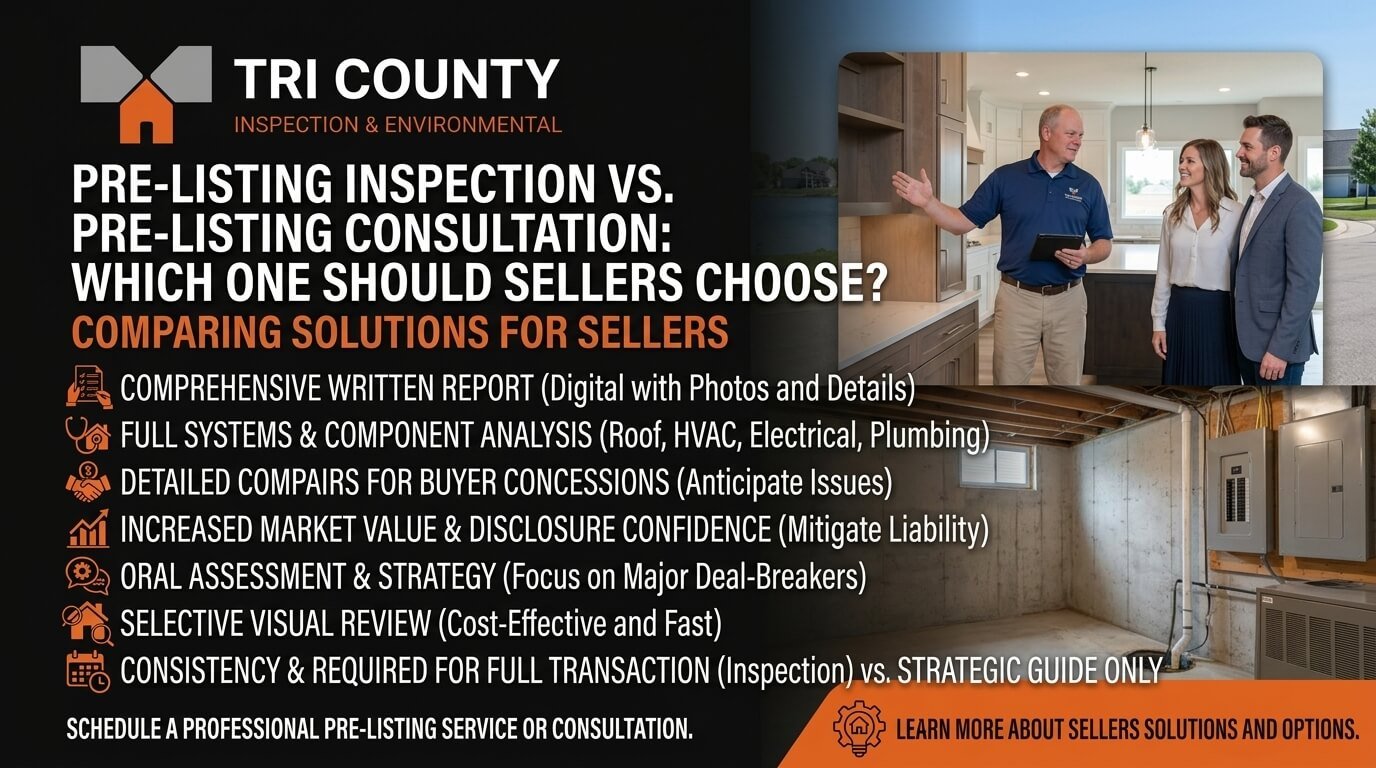
There are two ways to get ahead of that. A pre-listing inspection is a complete inspection of the home before it goes on the market. A pre-listing consultation is a shorter, more focused walkthrough with an inspector who points out the issues most likely to come up. Both are useful. They are not the same thing, and the right choice depends on the house, the market, and how you plan to sell.
What Is a Pre-Listing Inspection?
A pre-listing inspection is a full home inspection ordered by the seller instead of the buyer. The inspector evaluates the same systems a buyer’s inspector would: roof, structure and foundation, exterior, attic and insulation, plumbing, electrical, heating and cooling, interior rooms, and other readily accessible components, and documents the findings in a written report with photographs.
The point is to see the house the way a buyer’s inspector will see it, before a buyer ever does. You learn what needs attention while you still control the timing, the contractor, and the price.
What Is a Pre-Listing Consultation?
A pre-listing consultation is a shorter visit, usually a guided walkthrough with the seller or the listing agent. Rather than evaluating and documenting every system in full, the inspector focuses on the items most likely to draw attention from a buyer’s inspector: visible water staining, roof condition, electrical panel concerns, aging mechanical equipment, safety items, and talks through them on the spot.
You come away with a practical punch list and an experienced opinion on what matters most. You do not come away with a complete inspection report.
Side-by-Side Comparison
| Pre-Listing Inspection | Pre-Listing Consultation | |
| What it is | A complete inspection of the home, ordered by the seller | A focused walkthrough of likely problem areas |
| Scope | All readily accessible systems and components | Selected high-impact items |
| Time on site | Comparable to a buyer’s inspection | Shorter |
| What you receive | Full written report with photographs | Verbal guidance and a short list of priorities |
| Can be shared with buyers | Yes — many sellers offer it with the listing | Not designed for sharing |
| Relative cost | Higher | Lower |
| Add-on testing | Radon, sewer scope, mold, and other testing can be scheduled at the same time | Typically identifies whether testing is worth ordering |
| Best for | Older homes, higher-value homes, sellers who want no surprises | Newer or recently updated homes, sellers preparing a to-do list |
When a Full Pre-Listing Inspection Makes Sense
- The home is older. Wisconsin’s older housing stock is where surprises live: aging electrical systems, original sewer laterals, foundation movement, and decades of incremental updates.
- You want to price with confidence. Knowing the condition up front lets you either fix issues or price them in, instead of negotiating them down under deadline.
- You want to hand buyers a report. Offering the inspection with the listing signals transparency, and buyers who see a clean or well-documented report tend to negotiate less aggressively.
- You are selling from out of town or selling an estate or rental property, and have not lived with the house day to day.
- You want testing done early. Radon results, a sewer scope, or mold testing are far easier to act on before listing than in the middle of a contingency period.
When a Pre-Listing Consultation Is Enough
- The home is newer or has had major systems replaced recently, and you mainly want a professional second opinion.
- You are preparing a to-do list before listing and want to know where to spend your repair budget first.
- You are deciding whether a full inspection is worth it. A consultation can tell you whether the house warrants one.
- You are working with your agent on presentation and want an inspector’s eye on the items buyers notice most.
A Note on Wisconsin Seller Disclosure
In most Wisconsin residential sales, sellers complete a Real Estate Condition Report disclosing defects they are aware of. Anything you learn from either a pre-listing inspection or a pre-listing consultation becomes something you are aware of. That is not a reason to avoid either one; a buyer’s inspector will find the same conditions anyway, but it is worth understanding before you schedule. Many sellers find it simpler to repair the item, or disclose it with a repair estimate, than to have it surface late in the sale.
This is general information rather than legal advice. Your listing agent or a real estate attorney can tell you exactly what your disclosure obligations are for your property.
What to Do With the Results
Whichever option you choose, the findings usually fall into three groups:
- Fix before listing: safety items, active leaks, and anything inexpensive that would otherwise look like neglect in a buyer’s report.
- Disclose and price in: larger items such as an aging roof or older furnace, where a contractor’s quote lets buyers see the real cost instead of guessing high.
- Leave alone: cosmetic and minor maintenance items that every house has and buyers expect.
Keep receipts and contractor invoices for anything you repair. Buyers and their inspectors respond well to documentation.
Which One Should You Choose?
If the home is older, if you want to share a report with buyers, or if you simply want no surprises during the sale, choose the full pre-listing inspection. If the home is newer, recently updated, or you mainly want guidance on where to spend money before listing, a pre-listing consultation is a practical, lower-cost starting point. Either one puts you in a far stronger position than waiting for the buyer’s inspector to tell you what is wrong with your house.
Frequently Asked Questions
1. Is a pre-listing inspection the same as a buyer’s home inspection?
It covers the same systems and components and produces the same kind of written report. The difference is who orders it and when: the seller orders it before the home is listed, so the seller controls what happens with the findings.
2. Do I have to share my pre-listing inspection report with buyers?
Sharing the report itself is a choice many sellers make to build buyer confidence. Separately, Wisconsin sellers generally must disclose known defects on the Real Estate Condition Report, and anything the inspection reveals becomes known to you. Your listing agent can advise on how best to handle both.
3. Will buyers still order their own inspection?
Usually, yes, and they should. A pre-listing inspection does not replace the buyer’s inspection, but it means far fewer surprises come out of it, which tends to make negotiations shorter and smoother.
4. How far ahead of listing should I schedule a pre-listing inspection?
Early enough to act on what it finds. Scheduling a few weeks before you plan to list gives you time to get contractor quotes, complete repairs, and update your disclosures without delaying the listing.
5. Can I add radon testing or a sewer scope to a pre-listing inspection?
Yes, and it is often worth doing. Radon testing and a sewer scope inspection are two of the findings that most often surprise sellers late in a sale, and both are far easier to address before the home is on the market.
6. Is a pre-listing consultation enough for an older home?
Sometimes, but for older Wisconsin homes, a full inspection is usually the better investment. A consultation focuses on the most visible issues; older homes are where the less visible ones, such as wiring, sewer laterals, and foundation movement, tend to be.
Schedule a Pre-Listing Inspection in Southeastern Wisconsin
Tri County Inspection & Environmental helps sellers across southeastern Wisconsin, including Madison, Milwaukee, Waukesha, Delafield, Lake Geneva, and Janesville, prepare their homes for sale with detailed inspections and environmental testing. Not sure which option fits your home? Call us, and we will help you decide.
Call 262-225-9668 or book online.